


 Cart
Cart
 sales@molnova.com


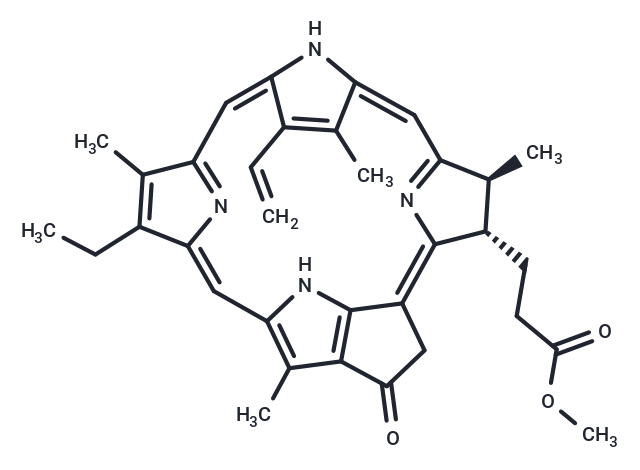
Methyl pyropheophorbide-a
CAS No. 6453-67-4
Methyl pyropheophorbide-a( —— )
Catalog No. M34657 CAS No. 6453-67-4
Methyl pyropheophorbide-a (MPPa) is a chlorine photosensitizer and a derivative of chlorophyll a. It is photodynamically active, induces apoptosis and inhibits tumor growth, and can be used in photodynamic therapy (PDT) of cancer.
Purity : >98% (HPLC)
 COA
Datasheet
HNMR
HPLC
MSDS
Handing Instructions
COA
Datasheet
HNMR
HPLC
MSDS
Handing Instructions
| Size | Price / USD | Stock | Quantity |
| 2MG | 49 | In Stock |


|
| 500MG | Get Quote | In Stock |
|
| 1G | Get Quote | In Stock |
|
Biological Information
-
Product NameMethyl pyropheophorbide-a
-
NoteResearch use only, not for human use.
-
Brief DescriptionMethyl pyropheophorbide-a (MPPa) is a chlorine photosensitizer and a derivative of chlorophyll a. It is photodynamically active, induces apoptosis and inhibits tumor growth, and can be used in photodynamic therapy (PDT) of cancer.
-
DescriptionMethyl pyropheophorbide-a (Pyropheophorbide-a methyl ester), a chlorophyll-a derivative, is a potent photosensitizer that can be used in photodynamic therapy (PDT) of cancer. Methyl pyropheophorbide-a has photodynamic activity and can induce apoptosis and inhibit tumor growth.
-
In VitroPyropheophorbide-a methyl ester (2 μM; 12 h) inhibits the cell cycle progression from the G0/G1-phases and induces apoptosis at the light dosage of 55.6 kJ/m2 in PC-3M cells.Pyropheophorbide-a methyl ester (0.2-15 μM; 20 h) has no signi?cant dark cytotoxicity in NCI-h446 cells.Pyropheophorbide-a methyl ester (0.1-15 μM; 20 h) mediates a dose-dependent photocytotoxicity in the NCI-h446 cells.Pyropheophorbide-a methyl ester (2-4 μM; 0-24 h) induces apoptosis of NCI-h446 cells in a time-dependent manner.Pyropheophorbide-a methyl ester (0.5-4 μM; 0-20 h) shows a photocytotoxicity in PC-3M cells.Apoptosis Analysis Cell Line:PC-3M cells Concentration:2 μM Incubation Time:12 h Result:Apoptosis rate was about 0.27%, 6.15%, 20.49%, 50.76%, 65.39%, 64.92%, and 64.37% at 1, 3, 6, 12, 18, and 24 h posttreatment, respectively under the conditions of LC75 (2 μM+55.6 kJ/m2).
-
In VivoPyropheophorbide-a methyl ester (15 mg/kg; tail vein and topical injection) inhibits the growth of PC-3M tumors in mice.Animal Model:Male BALB/c nude mice (6-8 weeks, 16-20 g) bearing PC-3M tumor Dosage:15 mg/kg Administration:Tail vein injection and topical injection Result:The tumor volume and the weight inhibition rate were 46.78%, 41.84% in tail vein injection group and 78.66%, 72.07% in topical injection group, respectively.
-
Synonyms——
-
PathwayApoptosis
-
TargetApoptosis
-
RecptorApoptosis
-
Research Area——
-
Indication——
Chemical Information
-
CAS Number6453-67-4
-
Formula Weight548.67
-
Molecular FormulaC34H36N4O3
-
Purity>98% (HPLC)
-
SolubilityIn Vitro:?DMSO : 2.5 mg/mL (4.56 mM; Ultrasonic (<60°C)
-
SMILESCCc1c(C)c2cc3[nH]c(cc4nc([C@@H](CCC(=O)OC)[C@@H]4C)c4CC(=O)c5c(C)c(cc1n2)[nH]c45)c(C)c3C=C
-
Chemical Name——
Shipping & Storage Information
-
Storage(-20℃)
-
ShippingWith Ice Pack
-
Stability≥ 2 years
Reference
1. Sun X, et, al. Photodynamic therapy with pyropheophorbide-a methyl ester in human lung carcinoma cancer cell: efficacy, localization and apoptosis. Photochem Photobiol. 2002 Jun;75(6):644-51.?
molnova catalog



related products
-
Millepachine
Millepachine is a natural product found in the Chinese herbal medicine with strong antitumor effects against numerous human cancer cells.
-
Methylisoindigotin
Meisoindigo(Natura-α; N-Methylisoindigotin; Dian III), a derivative of Indigo naturalis, might induce apoptosis and myeloid differentiation of acute myeloid leukemia (AML).
-
CGP 3466B maleate
Omigapil maleate is an orally bioavailable GAPDH nitrosylation inhibitor. Omigapil maleate abrogates Aβ1-42-induced tau acetylation, memory impairment, and locomotor dysfunction in mice.
